Tuesday, September 18, 2012

Tree houses.. Those still exist?

My family!
Growing up, I was an active kid. For what ever reason, my parents always kicked me outside to play. After reading Louv's The Last Child in the Woods I immensely became grateful for what my parents 'forced' me to do. A few days after our class discussion on ADHD in relation to playing outside I got a call from my sister. My sister, who is 2 years my senior, called to tell me her professors had recommended her to see an educational psychologist. Immediately her words caught my attention and I dropped everything to listen to her. She had spent a day in testing for educational disabilities and at the age of twenty-three she was first diagnosed with ADHD. At first I was skeptical- she had done just fine all through school and had even managed to score a spot in one of the most rigorous nursing programs in the country. After seventeen years of formal schooling how was it that she was just now diagnosed?

Chelsea, my sister, getting ready for clinical days. 


After talking to her for a while about life, school and her study habits I could not help but think- are the increased rigorous academic programs contributing to an elevated diagnosis of ADHD. Her program a traditionally twenty-seven month program condensed into an eighteen consecutive month program. Her life consists of studying, attending clinical days and little sleep and as result of this she has little time to properly take care of herself- fastfood, little exercising and even less time spent outside.

The rate of 13-18 year olds being diagnosed with ADHD has
sky rocketed in the past few years. 
So are these intense study programs causing an increased diagnosis of ADHD and other educational disorders in the older students populations? It only makes me wonder. Are we driving students to mental breaking points in education. Is our increased focus on trying to be better then all else driving us to develop horrible habits? Louv mentioned in his book a theory that some children are just better able to adapt in today's world. Is that really what happens?

While I do not fully agree that being outside all the time will solve the ADHD problems, I do believe the lack of being outside is contributing to the increased rate of ADHD. With more time in school, lectures, studying and the increased pressure of being involved in EVERYTHING are we driving kids to a breaking point by making them focus on academics all the time?


Saturday, September 8, 2012

Lessons from Africa for Americans!


Aldo Leopold's, The Land Ethic, absolutely enthralled me. Spending my summer in Africa, I was exposed to a new way of living- in every way possible. Coming back into America and subsequently being thrown in Colloquium three days later has intensified how much I see the need for a change in the way I chose to live- the way we chose to live in America.

Teaching farmers a sustainable way to clear land. Zambia
While much of the reading we had with The Land Ethic caught my attention, the section on The Land Pyramid made me think back to my time in Africa. In this section, Leopold talks about how the biotic pyramid is misunderstood within the context of conservation education.

Biotic Pyramid
This biotic pyramid is complex web of lines and levels, mixing and turning but yet it some how manages to maintain and support the Earth. One thing depends on another and another and another. When one part of the biotic pyramid goes missing, the whole chain is thrown off and the chain struggles. It can either attempt to adapt or it will fail all together. So what does this all mean? And how in the world does this connect to Africa?

Well, when you see the Earth, the cycles, the processes in terms of the biotic pyramid it means that life has to start somewhere. That somewhere is the soil we stand on, the ground we walk over daily. Soil is not simply soil- it is the start of the food chain, the foundation of the energy chain. During my time in both Malawi and Zambia we were given the opportunity to teach a program called Farming God's Way. It is a conservation farming method taught to all to help improve crop yields. (Most farmers us the slash-and-burn technique which ruins the land and significantly decreases the crop yield.) I specialized in teaching the management portion of the program and in this section, I was able to teach the simple concepts of the biotic pyramid- how everything in life God has created to rely on one another.

Farming God's Way training in Nsaru, Malawi 
You see, being an American and now reading Leopold's essay puts me into the hypocrite category- big time. I preached about how we should use every part of the land in a sustainable way. I said we in America do that. We use the land to in an honorable and land sustaining way, but we don't. Both as African's and American's we use the land in a way that takes away from it, ways that disrupt the biotic pyramid. I am deeply convicted about my misrepresentation of how I saw the use of resources in America.

So how is it that we use the Earth in a sustainable, God honoring manner? And, even more is the question of how many American's think that our conservation methods are good? If we are a product of our environment have created a correct environment about sustainability?

Thursday, August 30, 2012

Thirty two Kenyans... One American. Commonality?


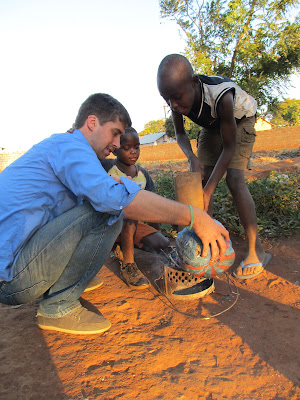
Who needs a real football when you can make a better one
from bags and fire? 

This summer I had the amazing opportunity to live in the villages of Zambia and Malawi for a month each. While there our team was treated to as much normal village life as the culture would dictate. Being Azungu’s, or white people, we were treated like guest everywhere we went. As time went on the families we lived with begin to not see us as guest but as people and they allowed us to experience more of village life.

When we were allowed to really experience village, my eyes were opened, more then they were when we first entered the village. Sure, at first village life is fun- it’s like camping (and who doesn’t love camping?) but as time went on I was convicted about how incredibly WASTEFUL we as Americans are but I also saw and in a few cases experienced how our wastefulness and consumer-hungry society was beneficial to our health.

In Hot, Flat and Crowded Friedman gives a statistic that is mind-boggling and since reading it, I cannot get it off my mind- mostly because it hits home so hard. He reports that it takes THIRTY-TWO Kenyan’s to consume as much as a single American. Ouch. While I did not spend my summer in Kenya, conditions in Zambia, Malawi and Kenya are close. If you haven’t been around thirty-two Africans before, let me tell you something- they consume A LOT and I really mean A LOT, but we also consume overly excessive amounts of, well, everything.

Africa from space at night. Not much light is being used.
So, if Africa contains a sixth of the worlds population and only contributes to four percent of consuming energy, could we learn a lot of lessons from them? Lessons that would save our planet? I think so!

During our time in the villages we often encountered families that would save up for several seasons to buy solar panels, and these solar panels ran everything. If it needed power, it ran it. Light? Yes. TV? Yes. Computer? Yes. Fan? Yes. Stove? You got it! Air conditioner? Uh huh! Not only did it use solar energy, they were also only using what they could afford (to buy the equipment) and what they could collect (sunlight). They took pride it what they owned. We learned that we really do not need electricity every minute of every day. Ultimately it comes down to this- do we want comfort for a relatively short-term amount of time or do we want to learn a new comfort level and leave the world a livable place for the next generations.


While electricity is only one of the many things that we could learn to integrate into our lifestyle to reduce consumption, there are a few lifestyle adaptations we should NOT adopt. During our time in the villages we were often treated to delicacies (that were not so delectable). Toward the end of stay we were indulging in yet another delicacy and within twenty-four hours the team came down with food poisoning. To keep it mild, our bodies were rejecting everything in every way possible and we were left bed (rather bathroom) ridden for two straight days. While eating every part of an animal is resourceful, it is potentially harmful to the human body. This in turn increases our consumption of other resources.

Our final night in Zambia we had to give the family a taste from America- s'mores!
We made our fire from maize cobs that had been shelled earlier in the day. Using every part of everything they are given!  


So can Africa learn a lot from developed countries? Of course! But can America learn a lot from Africa and their simply way of life? Absolutely! Ways that would better lives, communities and ultimately the Earth for all!